SUBSIDIARITY
Subsidiarity is a principle of governance that refers to making decisions at the most local level that is possible, practical, and effective. If a decision can be made at a lower level, the higher governance unit should cede the right to do so. Subsidiarity, combined with nesting, enables us to establish and govern sustenance systems at various scales.
Historically, subsidiarity has been an important organizing principle for federalism, including the United States, where sovereignty has been with the states and the federal government’s role has been subsidiary. Currently, however, the central government’s role has expanded to be primary, especially in energy, transportation, and defense.
In the realm of urban planning, the United States has experienced a rare level of decentralization, especially after the adoption of zoning by local governments via state enabling legislation. Today most land use and infrastructure decisions are made by municipalities: counties, cities, towns, and villages.
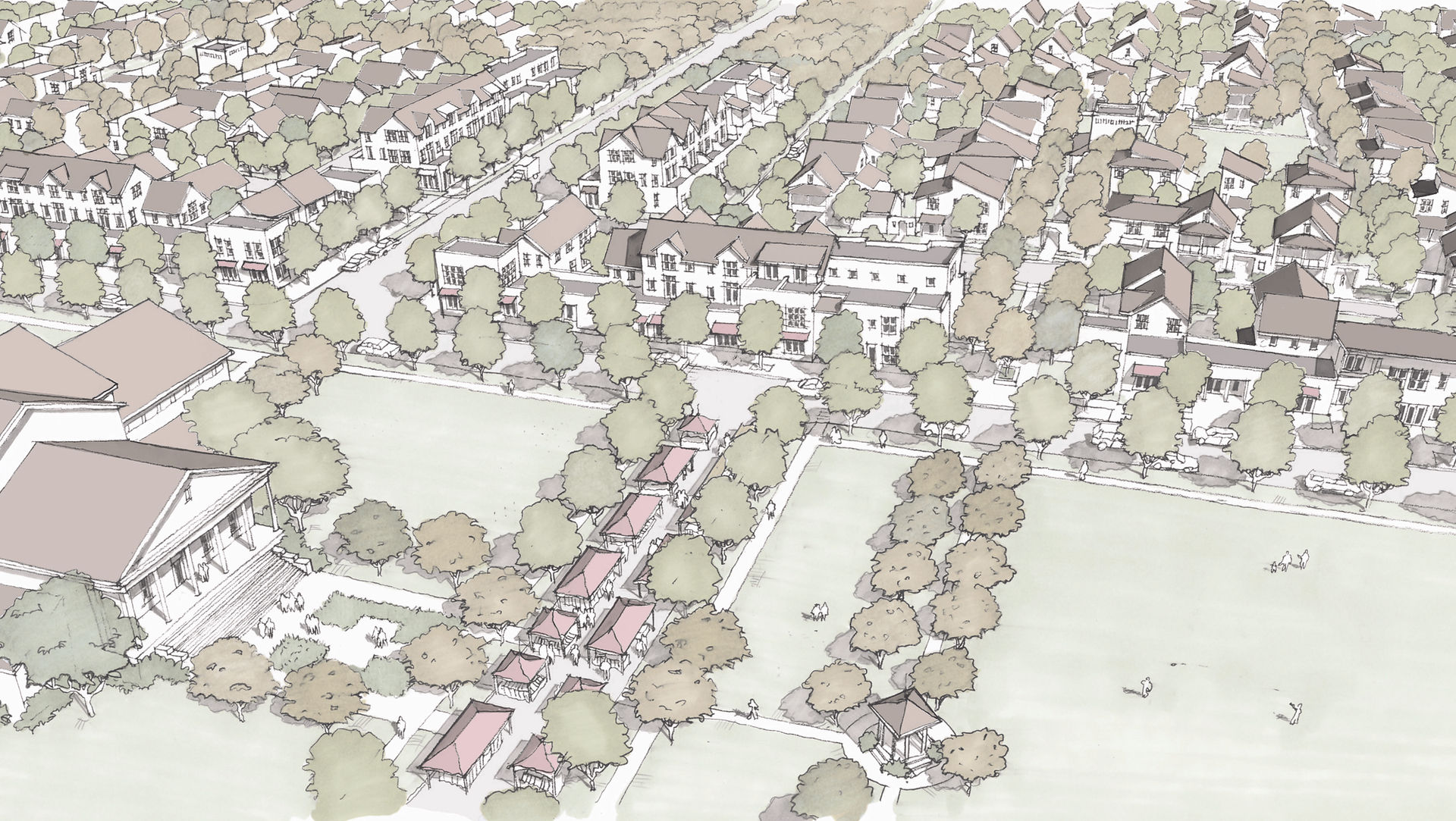
The kind of localization advocated by hyperlocal urbanism, achieving self-sufficiency at walking shed scale, requires fine levels of governance, decision-making, and management that bridge the gap between the individual household and City Hall.
A well-structured governance system that coincides with the physical elements of the community, such as compounds, blocks, quadrants, and neighborhoods, enables many varieties of roles and purposes. To work, they need to be formulated and stated clearly. This is easier when the scale is more local and the level of interdependence is clear.
Hyperlocal urbanism calls for zoning reform where a dynamic regulation culture is involved with a development code that is not a preconceived static document forced by a top-down authority, such as a municipality, but an evolving language spoken by block, business row, and village scale management.
That language can guide construction, manage day-to-day enforcement of land use restrictions, and monitor productive activities within the block and business row to maximize synergies between them. Code enforcement needs to merge into the management of daily activities at local scales.
Even though the details of procedural structures will differ depending on location and context, subsidiarity should be the guiding principle for structuring review processes. For instance, building and occupancy permits for certain simple structures may be issued by block and business row management. Permits for larger and more complex structures may be issued by village and district managements. There may be multiple tiers in review processes as well.
Back