HYPERLOCAL URBANISM
Hyperlocal urbanism refers to localization in walking shed scale. It is possible to create a life that does not depend on large-scale regional sustenance systems which are likely to be disrupted or fail due to increasing climate disasters.
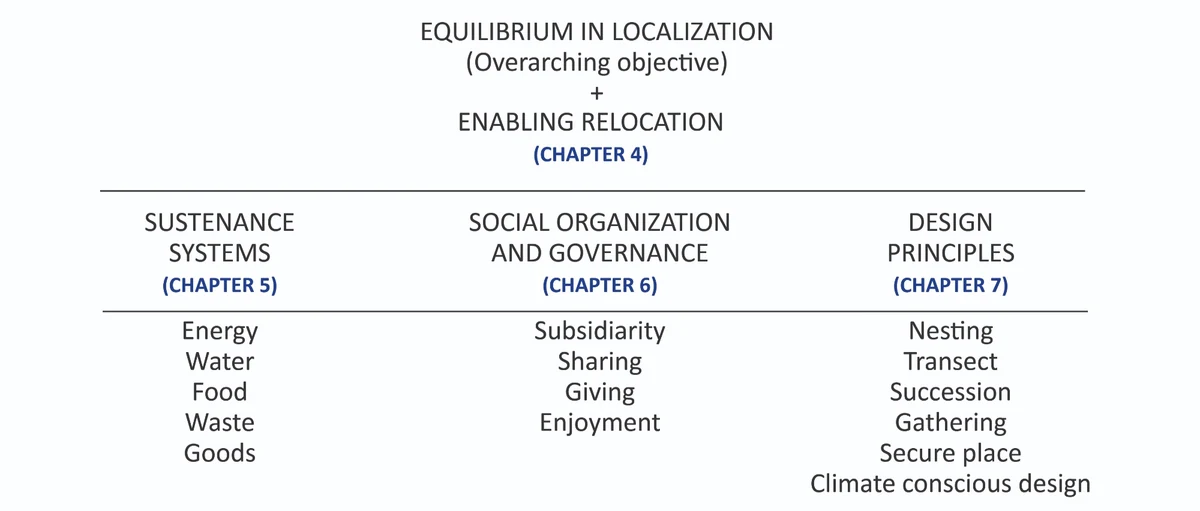
It is possible for us to be creative, productive, and supportive at local scales, so that we can achieve strong and diverse local economies that can sustain life. Localization of sustenance systems, adopting governance models together with appropriate social organizations, and the design principles for the right urban environment that can enable localization, are the three legs of the action framework of adaptation.
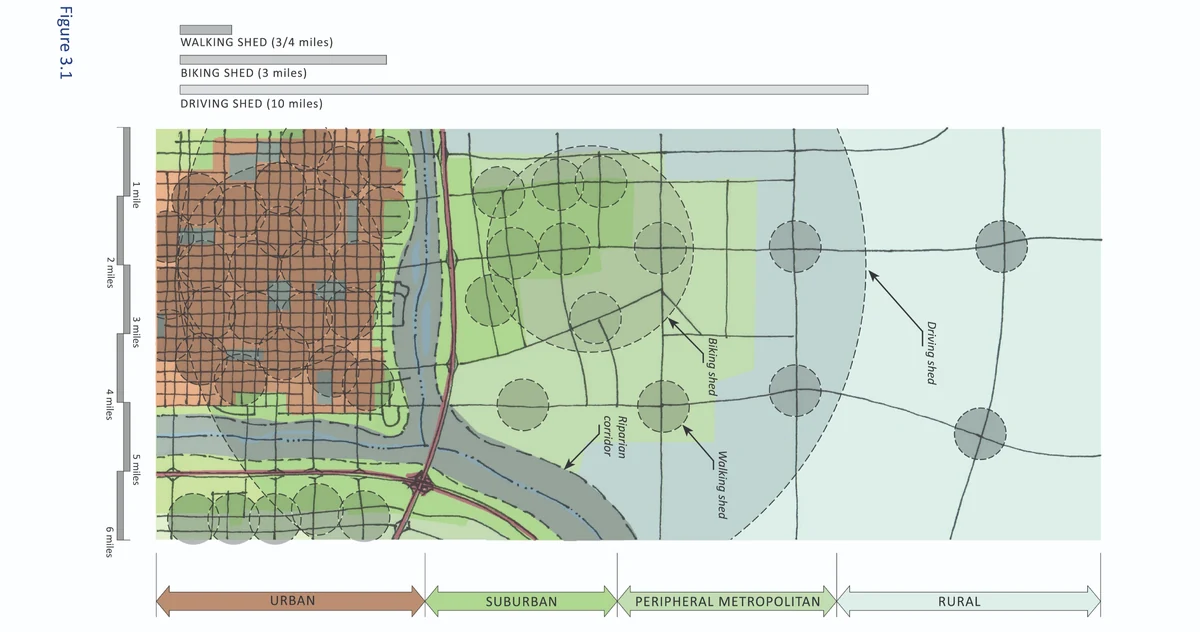
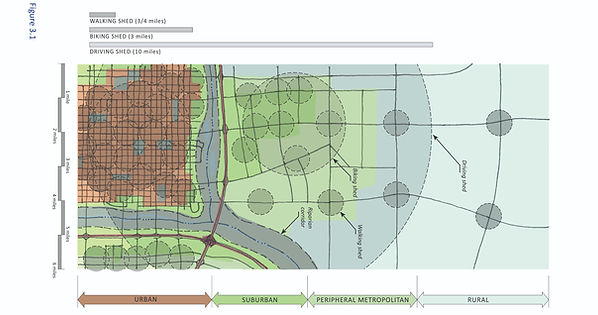
The walking shed is defined as a fifteen-minute walk from one edge of the settlement or neighborhood to the other. This means a circle with a three-quarter mile diameter based on the three-mile-per-hour average walking speed.
Traffic planners usually use a centroidal approach for defining sheds, where distance to the center is the primary concern, as in the case of transit stops. However, for hyperlocal urbanism, the field approach is more appropriate. It is focused on all trips that may happen within the settlement or neighborhood, not only trips to and from the center.
Hyperlocal urbanism suggests transformation in various scales, including infill developments in urban areas, suburban retrofit in suburbia, new communities within peripheral metropolitan land, and new towns in rural zones.
Hyperlocal urbanism is not aimed at isolation, but surviving through isolation if and when it is imposed by disruptions in large-scale sustenance networks. There is no reason why a self-sufficient entity cannot support another one. The objective is to create a system where self-sufficient entities interact with each other and create a network of lean economies.
Caring for others because others are needed to play their parts is inherent to self-sufficiency and hyperlocal urbanism. Self-sufficiency implies diversity and inclusivity as opposed to homogeneity and exclusivity. Diversity is essential to survive through the storm.
We need each other. People need access to most kinds of talent, craft, and knowledge in the vicinity. The more diverse the neighborhood we live in, the less vulnerable we will be. The likelihood is high that in the near future we will depend on each other to survive as we did in earlier, simpler, but equally fraught times.
Getting along with our neighbors will not be a matter of personal preference anymore, but a matter of necessity.
This brings us to three important conclusions. First, when and if large-scale systems fail, we will need a diverse set of services within close proximity. Second, this can be sustained only through strong local economies that are highly intentional and diverse. Third, inclusivity is essential to this level of diversity.